
Now Reading: Premier League chaos returns as goals and counters rise
-
01
Premier League chaos returns as goals and counters rise


The Premier League is already showing signs of a familiar twist: more goals, more running and more chaos. Early-season numbers suggest the division is moving away from controlled, set-piece-heavy football and back toward the frantic, end-to-end style that keeps fans on the edge of their seats.
Goals are rising again
The clearest sign of the shift is the scoring rate. The league’s average has climbed from 2.75 goals per game last season to 2.82 this year. That is only a modest increase on paper, but it comes with a bigger pattern behind it: in four of the past five seasons, the goal rate in the final stretch of the campaign rose by at least 0.21 compared with the first 50 matches.
If that same pattern repeats, the current season could finish as the second-highest scoring campaign in Premier League history. It is still early, but the signs are already pointing toward a more open and unpredictable title race, with fewer games being settled by fine margins alone.
More running, more transitions
Teams are also covering more ground than they did at the same stage last season. Every club is averaging more distance per match, and even Liverpool, bottom in this metric, are still ahead of any team’s final figure from the previous campaign.
That extra running fits the eye test. Matches are being played at a higher tempo, with more turnovers and faster attacks. The Premier League averaged the fewest Opta-defined fast-break shots among Europe’s big five leagues last season, but that figure has now climbed from 1.75 to 2.08 per game. That would have ranked second only to the Bundesliga in the previous campaign.
A league statistician familiar with the trend would probably describe it in simple terms: when the legs go, control goes with them. Right now, the legs are fresh, the pressing is aggressive and the counterattacks are arriving in waves.
Long-range strikes are back in fashion
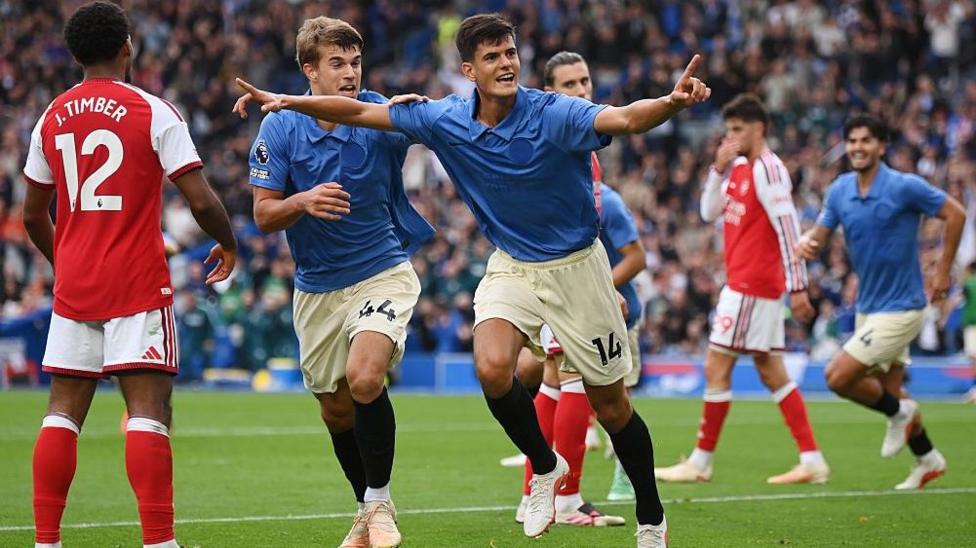
Another clear sign of the shift is the increase in goals from distance. Brighton have been one of the standout examples, already closing in on last season’s total of six long-range goals. Their 2-0 lead against Arsenal was built through strikes from outside the area, while Lewis Dunk produced a contender for goal of the season at Coventry, with Yasin Ayari also scoring from range in the same match.
Those moments matter because they show how the game is opening up. Defences are being dragged out, space is appearing around the box and players are taking more shots when they see a lane. The result is a more volatile, less predictable product.
Set pieces are less decisive
Not every part of the statistical picture is moving upward. Set-piece goals are down, and that is helping explain the rise in long-range efforts and open-play chaos. Nine teams are still waiting for their first set-piece goal of the season, including the champions, while two more clubs have only one such strike.
Matches are actually producing slightly more set-piece shots than last season, at 8.2 per game compared with 7.8. But the quality of those chances has dipped, with expected goals from set plays falling from 0.76 to 0.72 xG per match. As a result, set-piece goals have dropped from 0.71 per game to 0.56.
That may not sound dramatic in isolation, but small changes in chance quality can alter the entire rhythm of a season. Fewer reliable dead-ball goals means more pressure on teams to break opponents down in open play, where mistakes are more likely and transitions can become messy very quickly.
New managers, new uncertainty
There is another reason why the early weeks have felt so unpredictable: change on the touchline. The season has begun with more new managers than usual, and that often creates uncertainty on the pitch. Players are adapting to new ideas, new structures and new expectations, which can make matches far less stable.
That instability has shown up in the scorelines too. The 2-2 draw has already been the joint-most common result, appearing six times. Five of those games featured either both teams leading or one side taking the lead twice before being pulled back, which is a strong indicator of how frequently momentum is swinging from one end to the other.
As one analyst put it, “When teams are still learning the balance between control and risk, the Premier League becomes a much harder place to manage game state.” That has certainly been true so far.
A season that could still swing either way
There is still a long way to go, of course. Early-season trends can fade quickly once the calendar tightens and fatigue starts to bite. The winter schedule, European commitments and injuries may all drag the numbers back toward last year’s more measured pace.
For now, though, the Premier League looks lively, stretched and increasingly chaotic. Goals are up, fast breaks are up, long-range attempts are up, and the old sense that every game could flip in a heartbeat is firmly back.
Stat block:
| Goals per game last season | 2.75 |
| Goals per game this season | 2.82 |
| Fast-break shots last season | 1.75 |
| Fast-break shots this season | 2.08 |
| Set-piece goals last season | 0.71 per game |
| Set-piece goals this season | 0.56 per game |
If the numbers hold, this season could become one of the most explosive Premier League campaigns in years. And if they don’t, the opening weeks have already reminded everyone why chaos is such a powerful part of the league’s appeal.