
Now Reading: Saransh Jain’s Debut: A Mixed Bag for India vs Sri Lanka
-
01
Saransh Jain’s Debut: A Mixed Bag for India vs Sri Lanka


The Stage is Set for Saransh Jain’s Debut
Madhya Pradesh all-rounder Saransh Jain made his international debut in the second Test against Sri Lanka at the Sinhalese Sports Club Ground in Colombo, from August 23 to 27, 2026. Jain replaced the left-arm spinner Kuldeep Yadav, who was sidelined due to a viral infection. The match provided a golden opportunity for Jain to showcase his skills, backing a solid Indian side that had already secured a massive 165-run victory in the first Test at Galle.
This match was not just another Test; it was India’s chance to clinch the series and deliver a memorable whitewash against Sri Lanka. With a commanding position established in the first encounter, all eyes were on Jain to deliver against a team that was looking to bounce back. He was set to make a significant impact as the Indian bowling lineup needed versatility.
Match Summary and Performance
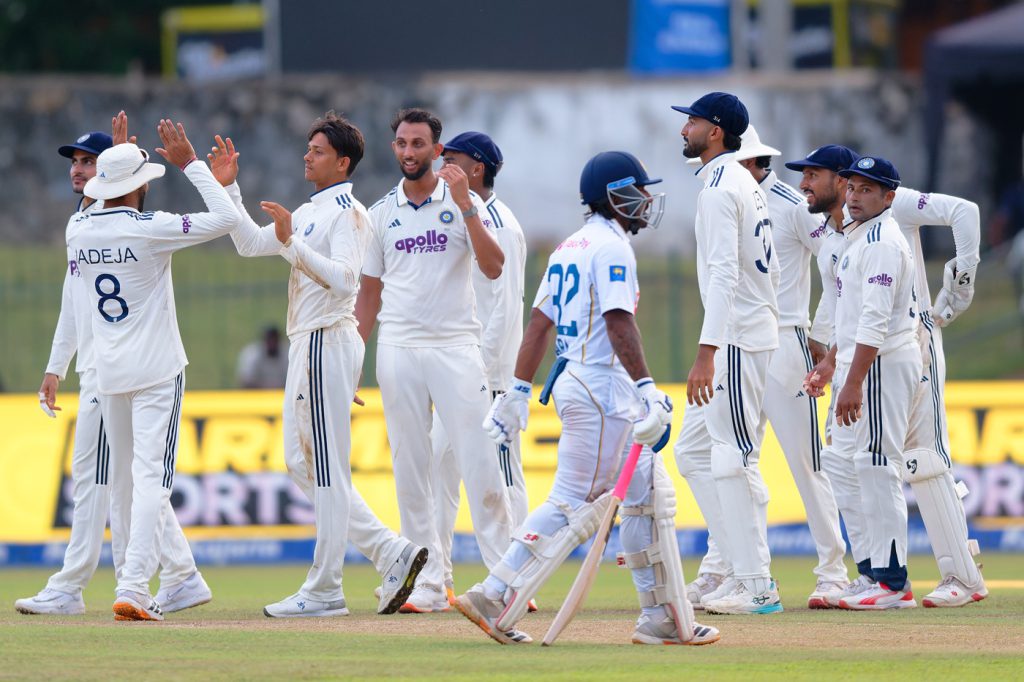
The second Test progressed with Sri Lanka posting 429 for 9 in their second innings after India enforced the follow-on, having established a substantial 213-run lead from the first innings. In match conditions favoring spin, Saransh managed to take 3 wickets but conceded a hefty 167 runs during his spell. The pitch, known for turning, presented an excellent opportunity for spinners, yet Jain’s performance raised questions.
Gavaskar’s Analysis on Jain’s Bowling
Former Indian captain Sunil Gavaskar was vocal in his critique of Jain’s bowling approach during his debut. He acknowledged the potential nerves that could affect a rookie cricketer stepping onto the international stage. However, he felt that Jain lacked the variety needed to genuinely trouble Sri Lanka’s batting lineup.
“The debutant off-spinner looked an honest trier with little variety to trouble batters at this level,” Gavaskar shared. “There was no deception through the air, and he over-relied on the pitch for assistance.”
Concerns Arise from the Lower-Order Batting
Gavaskar expressed particular concern regarding India’s inability to dismiss lower-order Sri Lankan batsmen effectively. He noted that if Jain struggled on a pitch with evident turn, it could lead to nervousness among Indian cricket fans.
“If they couldn’t dismiss the lower-order batters on a pitch where there was some turn, it does make Indian cricket fans a bit nervous,” he added. “There was a sameness to the bowling.”
The Impact of Kuldeep Yadav’s Absence
Another critical point raised by Gavaskar was the absence of Kuldeep Yadav, which he believed significantly affected India’s ability to wrap up the lower-order batsmen. Yadav’s unique skills as a wrist-spinner could have created the deception needed to dispatch Sri Lankan tailenders more efficiently.
“A good wrist-spinner can get the lower-order batters out in a jiffy most of the time,” Gavaskar concluded regarding Yadav’s absence.
In hindsight, Jain’s performance remains a mixed bag as he embarks on his international journey. His debut may not have met the high expectations associated with Indian spinners, yet it presents an opportunity for growth. As fans and analysts break down the events of the match, attention turns towards what this could mean for India’s future performances and player selections.