


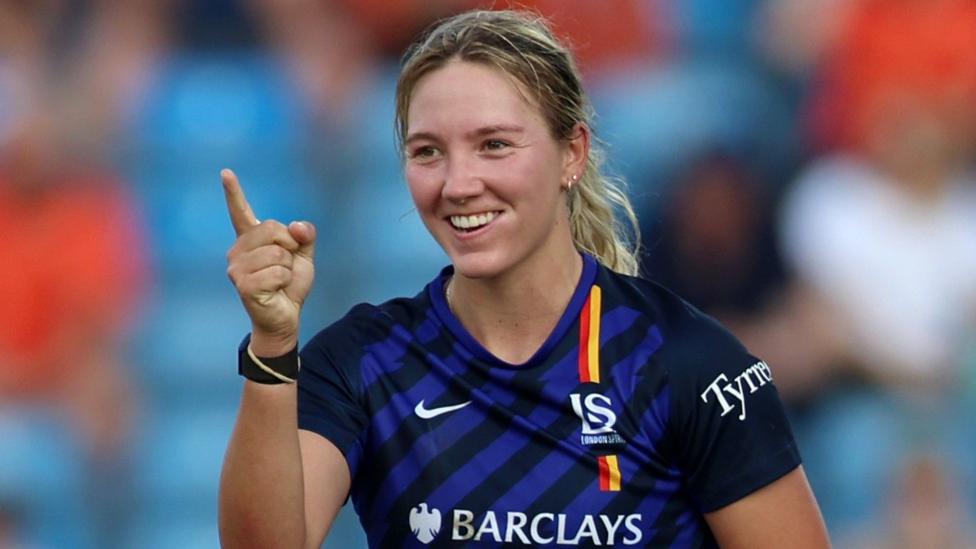
Katie George’s career looked as though it might be defined by what injuries took away. Instead, it is being reshaped by what she chose to build next. Once seen as a fiery young fast bowler with huge promise, the England cricketer has reinvented herself as a top-order batter and is back in the national conversation.
A career forced to change direction
George made her England debut against Australia in 2018 at just 18, arriving with the reputation of a tearaway quick bowler. But almost immediately, her progress was disrupted by a string of injuries that repeatedly halted her momentum and forced her to question whether continuing was worth the cost.
“I had a couple of conversations with my close family and partner about whether it was taking too much out of me and whether I was happy with the person I was,” George said. “I was pretty miserable.”
The injury list reads like a brutal setback timeline: nine stress fractures in her back, torn rib cartilage and ankle surgery, among other problems. For much of that period, she could not bowl and was used mainly for her athleticism and catching ability. At times, she admitted, it made her feel like an “empty uniform.”
The label that stung, and the shift that followed
Being called a “specialist fielder” may have been intended as praise, but for George it symbolised how far her game had drifted from where she wanted it to be. The comparison she feared most was to the archetype of the talented but injury-ravaged athlete whose career never quite reached its potential.
“For a long time I was worried about being the Daniel Sturridge – what could have been, all of that talent wasted,” she said. “I found that really difficult.”
That fear eventually led to a different kind of conversation at Warwickshire. Rather than asking whether she should walk away, George and coach Ali Maiden explored whether she could change the narrative entirely. If bowling was limited, could batting become the new strength?
George was sceptical at first. “I always knew I was half decent at bowling but I never had that feeling for batting,” she said. “I would always put it down to a fluke.”
The batting breakthrough
The turnaround has been remarkable. Batting most regularly at number three, George topped the averages in this season’s One-Day Cup with 77.55, a figure that underlines just how far she has come. It was not a gradual, quiet improvement either. It was a dramatic shift in role and output.
| Key batting numbers | Detail |
|---|---|
| One-Day Cup average | 77.55 |
| Highest score vs Blaze | 98 |
| First professional century | Vs Lancashire |
| Unbeaten century | Vs Durham |
Those innings changed perception quickly. A near-century against Blaze in April was followed by her first professional hundred against Lancashire in June, before an unbeaten ton against Durham completed a stunning campaign. She even opened in the T20 Blast, highlighting how much confidence has grown in her batting ability.
“It is crazy it happened but there was a lot of hard work and I am very grateful to Ali,” George said. “He pushed me and challenged me as to why couldn’t I change the narrative a little bit. I want to impact games. I don’t want to sit on the bench. I can do that from my sofa.”
England recognition returns
The response has been immediate. George will now travel to India for an England A tour beginning later this month, giving her another chance to impress selectors and coaches watching closely. The tour includes promising younger players as well as more established names such as Lauren Filer and Tilly Corteen-Colman.
England’s coaching and leadership structure will also be present, with Charlotte Edwards, Lydia Greenway and new managing director of women’s cricket Leah Poulton all due to be in India. That makes the trip more than a routine tour; it is a genuine audition for the next stage of George’s career.
There is also a deeper significance to the recall. Until recently, George said her proudest moment had been her senior England debut. Now, that feeling has changed. “Until the last few months it probably would have been my England debut but, once I thought about it, it was actually being stood in that team room as a batter and wearing this kit again,” she said. “If you said I would be here as a batter in England kit I would definitely have laughed and said you were smoking something.”
The future is still unwritten
George has not closed the door on bowling again, and she is not interested in any suggestion that she should simply stop chasing that side of the game. Her immediate focus is on keeping the batting momentum going and showing she can contribute at the highest level in a new role.
She also has a broader ambition in mind. “My dream would be to play a red-ball game for England,” she said. “That is what I set out to do. It is what I watched as a kid with my dad.”
That dream may still take time to materialise, but the most striking part of George’s story is that it is no longer about survival alone. It is about reinvention, resilience and a player refusing to be defined by injury. After years of uncertainty, England have found a cricketer who is not only back in the picture, but doing it in a way almost nobody saw coming.
“I want to impact games. I don’t want to sit on the bench.”
For Katie George, that line now feels like the clearest summary of a career that has taken an unexpected and inspiring turn.